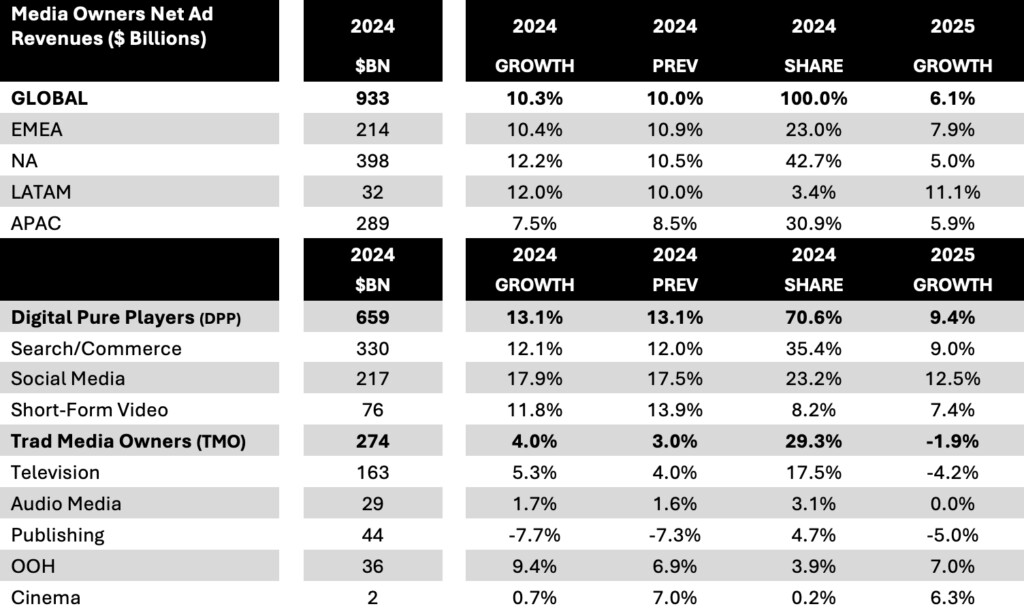
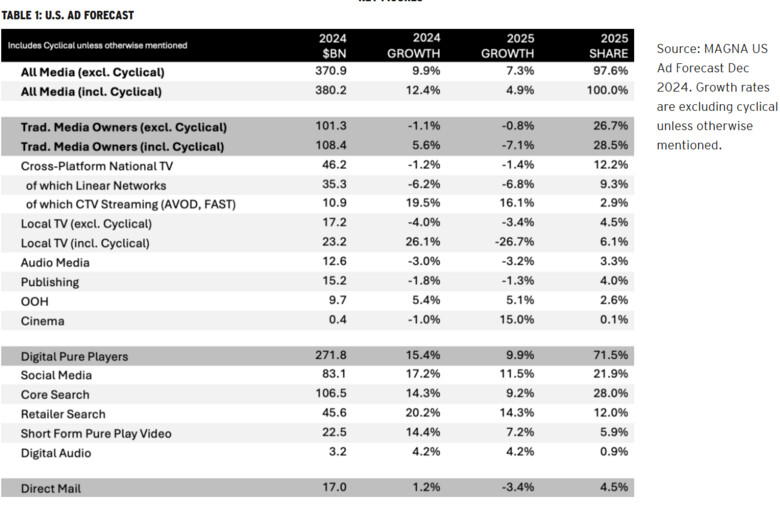
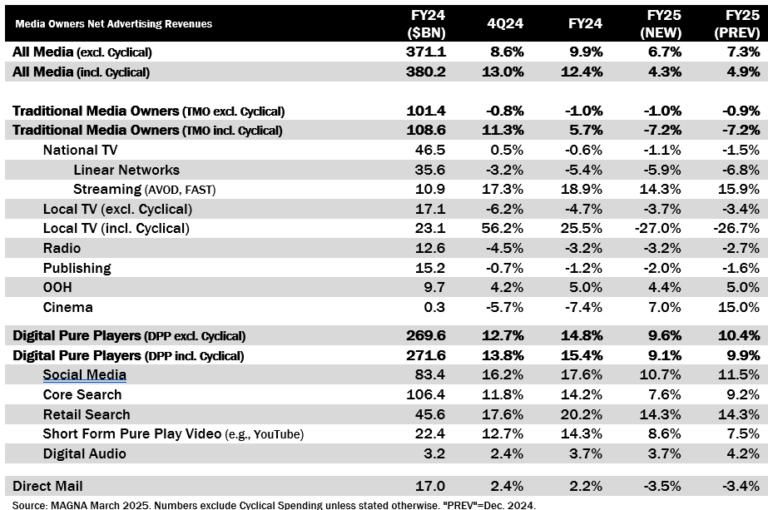
Magna December 2024 forecast: In 2024 ad revenues reached $933 billion, growing by +10.3%. Growth of 6.1% is expected in 2025.
After a strong first half (+12%), the global ad market slowed slightly in the second half (+8%). Expected to slow further in 2025, including digital.
Digital Pure Players (DPP) ad sales grew by double-digits through the year despite tougher comps in the second half.
+11% (Google), +22% (Meta), and +21% (Amazon), increasing their market share to 51% globally and 61% outside China.
“The strong growth of advertising spending in 2024, despite a challenging economic environment, was of course driven by an unusually high number of major cyclical events but, more fundamentally, media innovation is what attracts a growing share of marketing budgets into advertising formats. Digital Pure-Play ad formats (Search, Retail Search, Social and Short-Form Video) are fueled by the rise of Commerce Media redirecting billions of dollars from trade marketing into digital formats. The growing reach of ad-supported CTV streaming makes cross-platform long-form video more attractive to advertisers as it now offers scale on top of addressability and brand safety. With no major cyclical drivers in 2025, MAGNA expects ad spend growth rates to slow, but the organic factors will remain at work, stabilizing TMO ad revenues, and growing DPP ad sales.”
Analyst Brian Wieser from Madison and Wall lowered his US advertising revenue growth forecast for 2025 to 3.6%, down from a previous estimate of 4.5%.
Wieser attributes this revision to declining productivity caused by disruptions in international trade, rising inflation, and broader economic uncertainty driven by new tariffs.
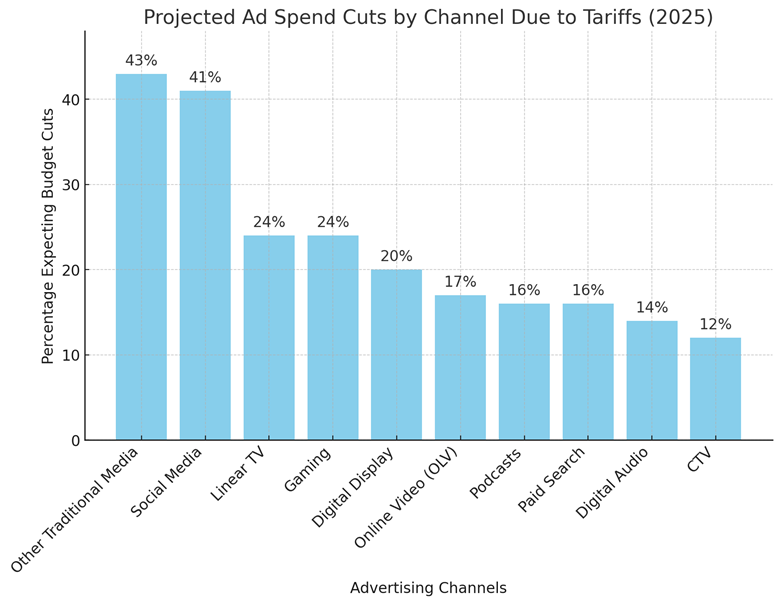
Tariffs, especially on imports from Canada, Mexico, and potentially Europe, are stating to impact ad budgets, particularly in the automotive and pharmaceutical industries.
Automakers alone represent between 7% and 13% of global revenue for major ad companies.
Pharmaceutical industry faces potential risks from tariffs targeting imports from Germany, Ireland, and Switzerland.
Assessment:@Aron slight revision down due to the uncertainty but still positive for 2025.
Since the economy still expected to grow between 1-2% (but lower than previous expectations), I think is accurate to not expect a full on decline in advertising but still a slowdown on its growth rate
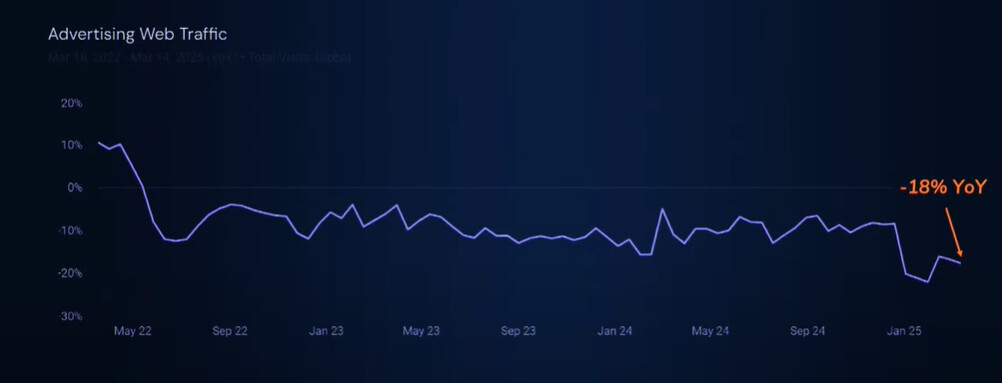
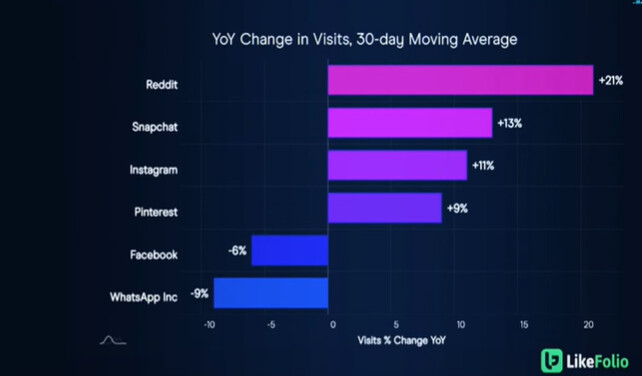
Likefolio says there has been a pullback in advertising web-traffic this year
Landon Swan, co-founder of Likefolio said we are seeing a pretty big pullback as far as interest in advertising platforms, about 18% drop in advertising web-traffic (min 0:45). He notes that this is probably priced in already.
Founded in 2013, Likefolio says it uses social media sentiment to understand consumer shifts.
I didn’t examine Likefolio’s credibility in detail but its calls seems to have been correct in the past. It called out Snaptchat’s redesign in 2018, which ended up being correct.
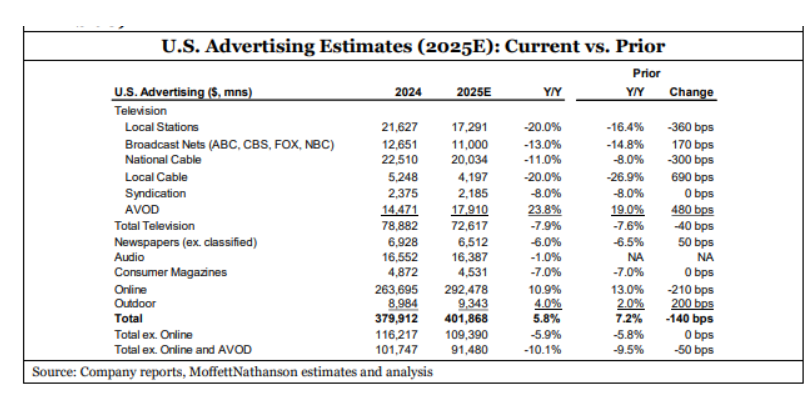
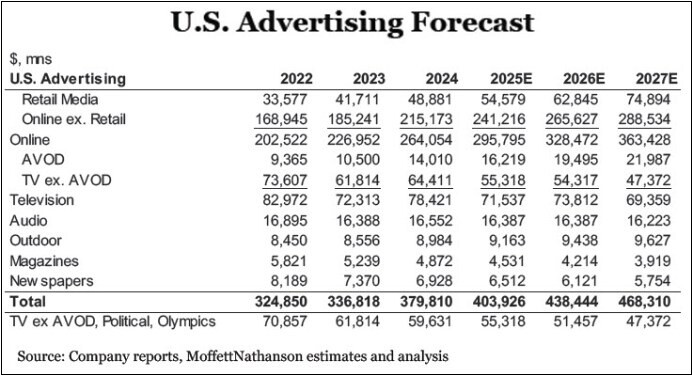
MoffettNathanson lowers US ad spend growth for 2025 to 5.8% from 7.2%
MoffettNathanson lowered their 2025 growth estimates for US advertising spend to 5.8% from 7.2%.
They lowered their estimate for online advertising to 10.9% from 13.0%.
The firm said its new outlook is based on public consumer companies reporting softer outlooks and advertising channel checks, where clients are becoming hesitant to deploy media spend amid growing uncertainty.
MAGNA reduces its 2025 ad market growth forecast from +4.9% in December 2024 to +4.3%.
MAGNA anticipates that the lack of visibility and risk of a trade war may cause marketing and advertising budgets to face freezes or cuts in industries that are most vulnerable to global trade, supply chain disruptions, and consumer confidence issues.
MAGNA expects negative GDP growth for the first quarter. The uncertainty will also lead to cautiousness in investment and marketing spending decisions for the months ahead.
CPG (food, drinks, personal care), quick-service restaurants, and autos are tied to global supply chains and prices, while also facing consumer scrutiny. They represent a sizable share of ad spend.
In contrast, other large industries like Pharma, Retail, Tech/Telecom, Entertainment, Finance, and Insurance are large, growing, and less sensitive to global costs or economic cycles.
Endemic and organic drivers (e.g. retail media, ad-supported streaming) have boosted ad spend beyond economic growth and will keep advertising formats attractive, encouraging steady or growing brand investment.
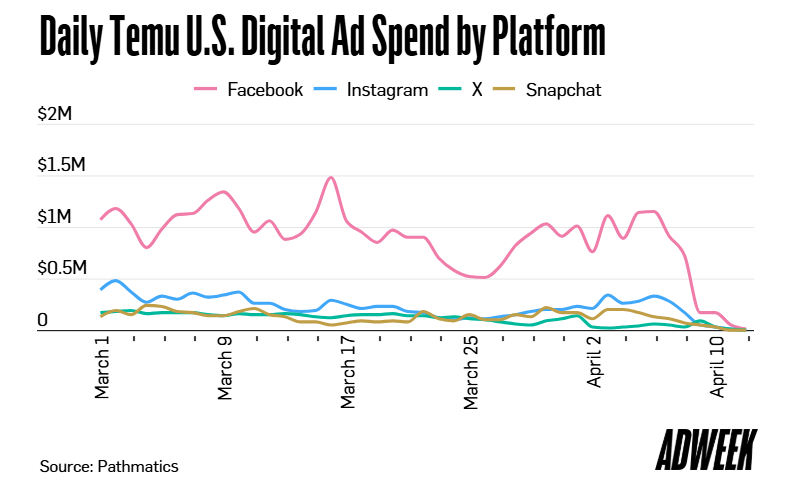
Temu is said to have been one of the largest spenders in Meta Platforms. According to the Wall Street Journal, Temu spent $2 billion in Meta ads in 2023.
Pathmatics, is a digital advertising intelligence platform owned by Sensor Tower, which served over 250 brands, media companies, and advertising agencies as of 2021.
WPP lowers global advertising revenue growth for 2025 to 6.0% from 7.7%
WPP lowers global advertising revenue growth for 2025 to 6.0% from 7.7% projected in December 2024, citing economic uncertainty and geopolitical tension.
It also lowered its forecast for 2025 to 2030 compound annual growth rate (CAGR) to 5.4% from 6.4% that they had projected for 2024-2029.
It lowered US advertising revenue growth forecast for 2025 to 5.6% from 9%.
WPP is a multinational advertising and communications company that has over 160 offices across more than 80 markets and manages approximately $63 billion in media spend.
I=7 Trump suspends de minimis exemption for all trading partners
President Trump signs executive order suspending de minimis exemption for all trading partners.
Around 62% of de minimis goods came from China in 2023.
Temu and Shein who were the major advertisers in Meta Platforms in 2024 are said to ship 30% of de minimis goods entering the US.
Trump already ended de minimis exemption for Chinese goods in April and there have been no noticeable impact on advertising spend in Alphabet or Meta Platforms.
WARC raised 2025 ad spend forecast by 1.2% to 7.4%
The World Advertising Research Center (WARC) projects global advertising spending to grow 7.4% y/y to $1.17 trillion, up from its June forecast of 6.2%.
It projects social media ad spend will grow 14.9% y/y to $306.4bn in 2025.
It projects ad market will grow 8.1% in 2026 to $1.27trn.
It projects ad market will reach $1.36 trillion in 2027, up 7% y/y.
“Despite economic headwinds, including disruption to global trade and reduced purchasing power among consumers, brands are doubling down on Meta, Alphabet and Amazon, while emerging players like TikTok are growing fast but from smaller bases,” said James McDonald, Director of Data, Intelligence & Forecasting, WARC.
Founded in 1985, WARC uses data from over 100 research partners across 100 markets, harmonized and verified through its HAVE methodology, and modeled with a proprietary neural-network system incorporating macroeconomic and media-revenue indicators.
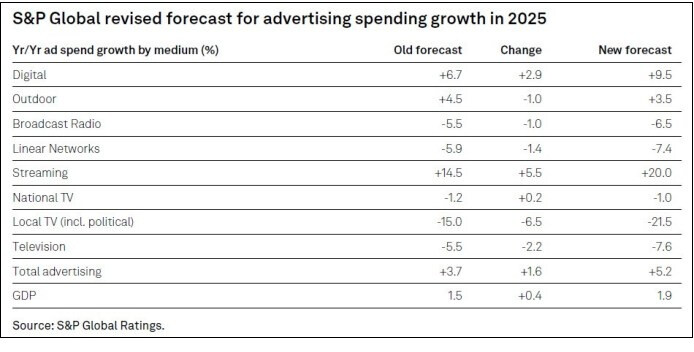
S&P Global raised 2025 growth estimates for US advertising spend to 5.2% from 3.7%
S&P Global said advertising remains solid after a “shaky” start start to the year.
“Advertisers’ concerns earlier this year over an economic slowdown due to the effect of tariffs on consumer spending have largely subsided,” says S&P.
“Digital advertising has sharply rebounded after a short-lived lull following the initial announcement of tariffs earlier in the year,” it says. “Advertising continues to shift toward digital platforms and the significant AI investments from the largest digital players are improving advertising efficiency, leading to growth.”
S&P Global forecast US ad spend will grow 6.3% in 2026.
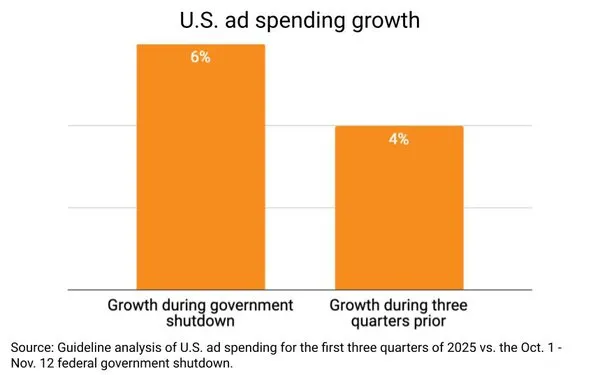
I=6 Guideline estimates US ad spend grew 6% y/y during the October 1 - November 12 shutdown
Guideline estimates that US ad spend grew 6% y/y during the October 1 - November 12 shutdown.
“While it is impossible to understand what long-term impact the government shutdown will have on the broader economy, we feel confident that the ad market will begin to show that impact long before the economic data will, especially in the pharma and travel sectors, which will feel more immediate effects," says Guideline Chief Insights & Analytics Officer Sean Wright.
Wright expects US ad market will weaken during the first half or 2026 "as consequences of the shutdown begin to make their way through the market.”
Guideline’s forward advertising booking data for November and December indicate that retail ad spend is flat y/y.
“Taken together, the categories give us some indication that advertisers remain cautious about the upcoming holiday season. Booking data is pacing slightly behind where it was last year so we are not in doom and gloom territory just yet. While the future is never easy to predict, the current booking data may be some of our best look into what might happen ahead of this year’s holiday season. And it looks flat,” Wright wrote.
Founded in 2020, Guideline collects and aggregates data on $156 billion worth of advertising spend across the world.
IAB cut its 2025 U.S. advertising spend growth forecast to 5.7% from 7.3%, expects social media ad spend to grow 14.3%, up from 11.9%
In its September 25 update, IAB cut its 2025 U.S. advertising spend growth forecast to 5.7% from 7.3%, citing a decline in sentiment among media buyers.
IAB said more marketers (42%) are focusing on performance or lower-funnel campaigns compared to February (35%).
It raised its forecast for social media ad spend growth rate to 14.3%, up from 11.9% in January.
“In our January report, we saw real concerns about the economy, and a shift toward performance-driven media. Now that shift is accelerating. If consumers are pulling back, that means every single dollar of ad spend has to earn a return,” said Chris Bruderle, vice president, industry insights and content strategy at IAB.
What are your interpretations here? What are importance ratings? Without more research it’s very hard to judge for me. They basically say based on their data ad spending was better than expected in Q4 so far (+6% y/y) but they expect the holiday season to be weak and flat y/y? (+ potentially more weakness coming in Q1?)
The 6% growth is for Oct 1-Nov 12 (federal government shutdown period). But they say bookings data for retail ad spend in November and December is flat y/y.
Yes, they think second half of next year could be weak, but I am still trying to find supporting evidence. Second half of 2026 is expected to benefit from FIFA World Cup and U.S. midterm elections.
Overall, I think their caution can’t be taken lightly given declining consumer spend. For Meta, I expect the headwind to be mild (to be investigated further) as ad spend continue to shift to performance marketing.