Strong Q2 2026 results expected for Meta Platforms, but rising AI capex remains a key investor concern
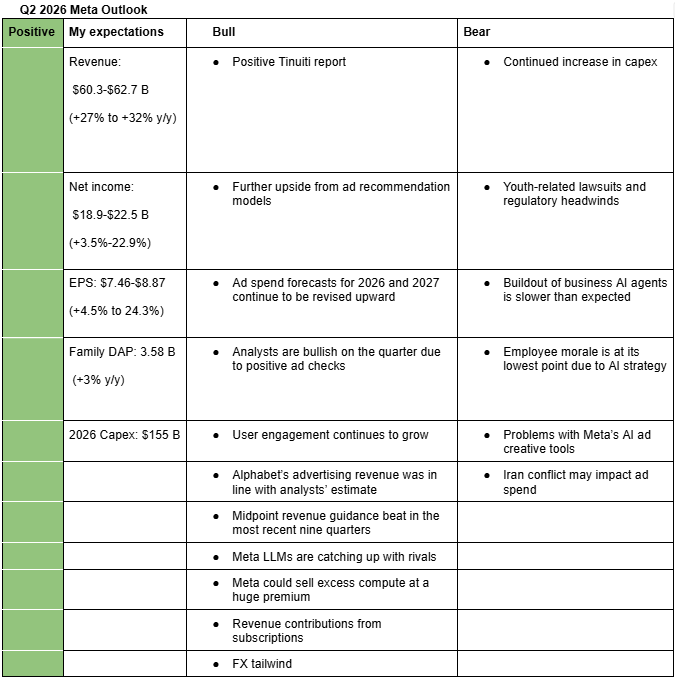
I am positive on Meta Platforms heading into Q2 2026 earnings. My Q2 2026 estimates (Meta Platforms (Google Sheets)) are based on positive Tinuiti report, positive ad spend checks, continued gains from Meta’s AI-driven ad models, FX tailwind, and Meta’s consistent guidance beats over the most recent nine quarters. Given the potential for Meta’s shares to come under pressure from a higher capex guidance and ongoing youth-related lawsuits, I maintain a Hold rating on the stock.
Bullish arguments
- Positive Tinuiti report: According to Tinuiti Ads Benchmark report (forum post), which has been consistently reliable in predicting Meta’s revenue growth, ad spend on Meta Platforms by Tinuiti advertisers rose 11% y/y in Q2 2026. Extrapolating from this report alone, Meta’s Q2 2026 revenue could grow by approximately 27-32%.
- Further upside from ad recommendation models: Meta continues to scale its ad ranking and recommendations models (Andromeda, Lattice, and GEM). For instance, in Q1 2026, it made enhancements to Lattice and GEM, resulting in a 6% increase in conversion rate for landing page view ads. They also still see a lot of room to continue improving recommendations throughout the year (Q1 2026 Meta Platforms Earnings (Notion)).
- Ad spend forecasts for 2026 and 2027 continue to be revised upward: Recent updates by leading advertising market research firms (Dentsu, Madison & Wall, PQ Media, WARC, and WPP) raises the 2026 average growth forecast global ad spend by 1.2 points to +8.9%. That of 2027 has also been slightly revised upwards (forum post). Additionally, Guidelines indicate that U.S. digital advertising spend (actual measurement) rose 10.9% and 9.4% y/y in April and May, respectively versus 9.5% in Q1 2026 (forum post).
- Analysts are bullish on the quarter due to positive ad checks: Analysts from firms such as Bernstein, Wolfe Research, Bofa, UBS, and Citi expect Meta to report solid results for Q2 due to positive ad checks (Q2 2026 Meta Platforms Earnings (Notion)).
- User engagement continues to grow: Citizens said their checks indicate Instagram engagement momentum continues. It pointed out that global time spent grew 13% y/y in June, marking the thirteenth consecutive month of double-digit growth (Q2 2026 Meta Platforms Earnings (Notion)).
- Alphabet’s advertising revenue was in line with estimates: Google’s Q2 2026 advertising revenue rose 14.4% y/y to $81.63 billion, roughly in-line with analysts’ estimate of $81.12 billion (forum post).
- Midpoint revenue guidance beat in the most recent nine quarters: Meta Platforms has exceeded its midpoint revenue guidance by an average of 3.9% in the most recent nine quarters (Google Sheets).
- Meta LLMs are catching up with rivals: Muse Spark 1.1 and Muse Image registered significant improvement in performance, with third-party tests indicating Muse Spark 1.1 outperforms Gemini models. This sends a strong signal that Meta’s Superintelligence Labs is now executing well and that its upcoming models will likely compete for the top spot.
- Meta could sell excess compoute at a huge premium: There is strong indication that Meta Platforms is joining cloud business. For instance, it recently hired AWS Senior Vice President Dave Brown (forum post) and Zuckerberg recently said (forum post) that it makes sense for Meta to explore it. There are also reports that Antropic is in discussion with Meta Platforms to lease compute worth $10 billion over two years (forum post). Given the strong demand for AI compute, Meta should be able to command premium pricing for its compute capacity and sign flexible short-term agreements. This reduces the risk of overbuilding compute capacity.
- Revenue contributions from subscriptions: Meta recently launched Facebook, Instagram, WhatsApp and Meta AI subscriptions. Based on the traction of Snaptchat+, Meta’s $3.99 per month subscription for Facebook, Instagram and WhatsApp could generate at least $3.3 B in incremental revenue (forum post). Evercore estimates the subscriptions could generate $10 billion-plus in revenue and $5 billion-plus in operating income by 2028 while Truist Securities estimate it could generate more than $20 billion in high-margin revenue by fiscal year 2030 (Q2 2026 Meta Platforms Earnings (Notion)).
- FX tailwind: Meta will again benefit from the strengthening of the foreign currencies against the U.S. dollar in Q2 2026. Management is guiding FX tailwind of around 2% while my estimate is around 1.1%-1.4% (Meta FX Estimate (Google Sheets)).
Bearish arguments
- Continued increase in capex: There are strong indications that Meta’s capex will continue to rise. I expect the company to raise its 2026 capex guidance by approximately $10–15 billion from the current range of $125–145 billion, driven by higher chip costs and additional lease commitments. I also expect 2027 capex to increase to approximately $225–250 billion, based on reports that Meta plans to bring 14 GW of compute capacity online next year, up from 7 GW in 2026 and around 1 GW in 2025 (Meta Platforms (Notion)).
- Youth-related lawsuits and regulatory headwinds: Fines associated with youth-related lawsuits could reach $45 billion based on current legal precedent. Additionally, Meta faces the risk of platform changes in the U.S. and Europe aimed at addressing allegations of addictive platform design. However, these lawsuits are likely to take years to resolve, resulting in some of the cases being dropped by plaintiffs and Meta not having to bear the full potential liability at once. Political interventions may also limit changes to its platforms design (forum post).
- Buildout of business AI agents is slower than expected: A recent internal memo indicates that Zuckerberg told employees that the buildout of business AI agents is slower than expected (forum post). Given that business AI agents are among Meta’s key AI monetization opportunities, slower-than-expected progress in their rollout could weigh on investor sentiment.
- Employee morale is at its lowest point due to AI strategy: Meta’s recent layoff, decision to track employee keystrokes and create applied AI unit seems to have negatively impacted employee morale (forum post). Sustained dissatisfaction could increase the risk of executive turnover, and potentially impact execution of Meta’s AI initiatives.
- Problems with Meta’s AI ad creative tools: A recent report indicates that Meta’s AI ad creative tools frequently generate inaccurate images, distorted products, and unintended modifications, requiring brands to manually review campaigns before launch (forum post). If these reliability issues persist, they could limit adoption and slow Meta’s efforts to displace traditional advertising agencies and creative firms. I had expected further market share gains from the adoption of these tools.
- Iran conflict may impact ad spend: An escalation of the U.S.-Iran conflict could drive higher energy prices, increasing inflationary pressures and weakening consumer spending. Lower consumer demand may prompt businesses to reduce advertising budgets, creating a potential headwind for Meta’s revenue growth. WARC estimates that a sustained U.S.-Iran conflict could reduce its 2026 global ad spend growth forecast by approximately 1.7 percentage points to 9.8% in a moderate scenario (forum post).
Management guidance and analysts' estimates:
Management Guidance for Q2 (Revenue): $58-$61 billion (+22.1% to +28.4%)
Analysts’ Estimate for Q2 (Revenue): $60.2 billion (+26.8%)
Analysts’ Estimate for Q2 (EPS): $7.20 (+0.9%)
Analysts’ Estimate for Q3 (Revenue): $63.2 billion (+23.4%)