(article to be written and added)
No, I havent. There is a high likelihood the government shut down due to a lack of agreement between the 2 parties.
But is still uncertain if it will happen or how long could last, for now, negotiations don’t seem to go well.
Some news about it:
Congress appears to be on track to trigger a government shutdown on October 1, 2023, because it is not expected to pass the 12 appropriations bills that fund government operations before the start of the new fiscal year.
Under the Antideficiency Act (initially passed in 1884 and amended in 1950), federal agencies cannot spend or obligate any money without an appropriation (or other approval) from Congress. When Congress fails to enact the 12 annual appropriation bills, federal agencies must cease all non-essential functions until Congress acts. This is known as a government shutdown. If Congress enacts some but not all of the 12 appropriations bills, only agencies without appropriations have to shut down; this is known as a partial shutdown.
Goldman Sachs estimates that a shutdown would reduce GDP growth by about 0.2 percentage point each week it lasts, and that growth would rise by the same amount in the quarter following the shutdown’s end.
What is a government shutdown? | Brookings
Some members of the hardline House Freedom Caucus, largely aligned with Donald Trump, are openly embracing a shutdown as a negotiating tactic to get their way on spending and conservative policy priorities.
Congressman Chip Roy, a Freedom Caucus member, last week described a shutdown as “almost” inevitable and warned: “We have to hold the line.”
The beleaguered McCarthy has said he hopes to move forward this week on an $886bn fiscal 2024 defense appropriations bill, which stalled last week as hardliners withheld support to demand a topline fiscal 2024 spending level of $1.47tn - about $120bn less than what McCarthy and Biden agreed to in May.
With a 221-212 majority, McCarthy can afford to lose no more than four votes to pass legislation that Democrats unite in opposing.
Republicans seem even further from resolution as US shutdown deadline nears | US Congress | The Guardian
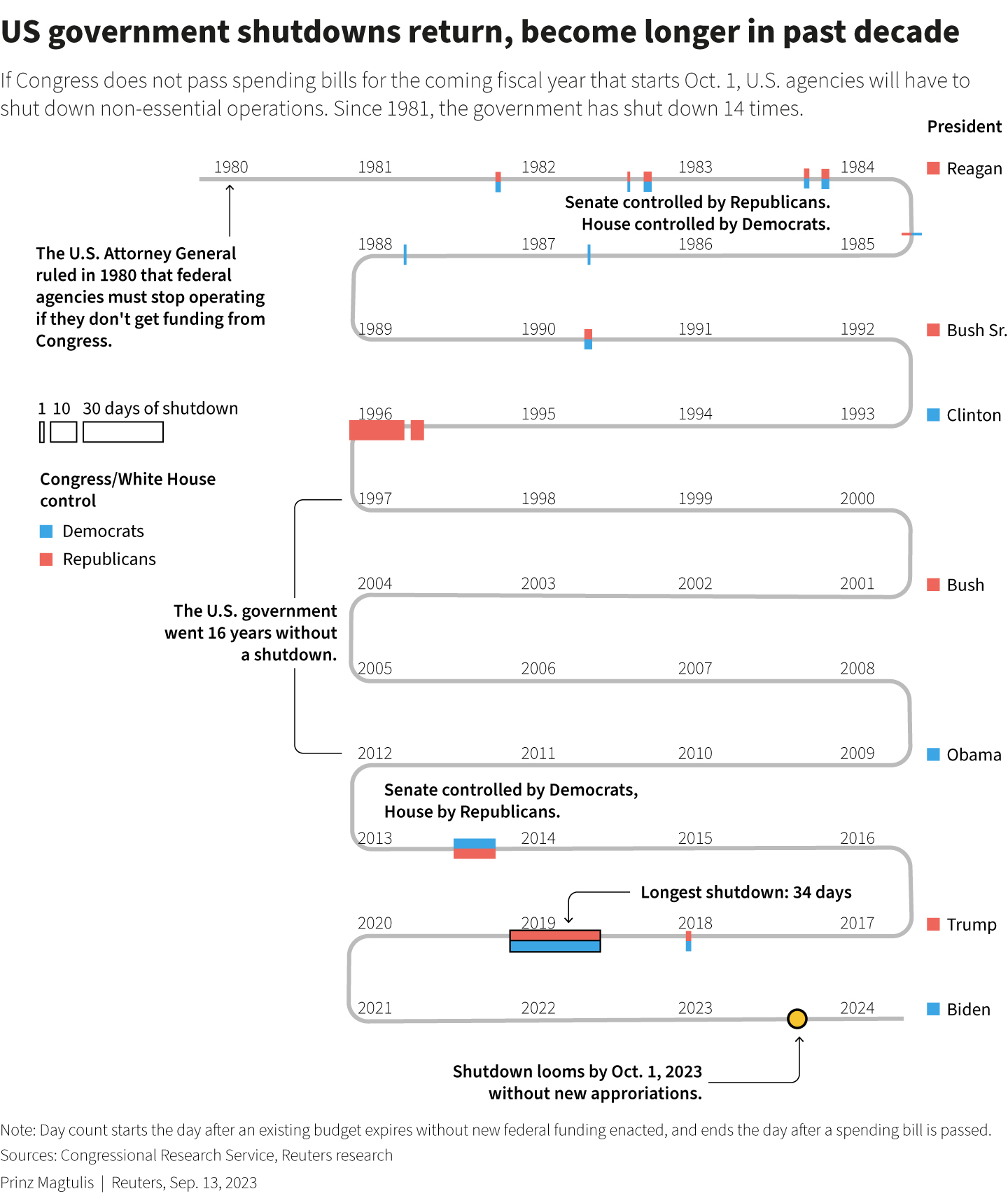
https://www.reuters.com/world/us/us-shutdown-looms-top-house-republican-kevin-mccarthy-faces-crucial-test-2023-09-18/
https://edition.cnn.com/2023/09/18/economy/bls-data-government-shutdown/index.html
1 Like
@Magaly it might make sense to write a short Wiki article about this topic in order to put things into perspective. Is my perception correct that the debt ceiling debate earlier this year was much more closely watched than this shutdown debate? What are the differences? I assume a failure to raise the debt ceiling would have had much larger consequences e.g. on credit rating, and social programs spending than a failure to enact the 12 annual bills? What would the exact consequences of a non-essential federal agency shutdown be and what would be practical examples of those consequences?
To me, it’s crazy that data from the Bureau of Labor Statistics is considered non-essential and it’s services might be cut.
I also do not fully understand why a government shutdown could not be avoided by Democrats and some Republicans cooperating.
Yes, sure, I will work on it.
Unfortunately, I think this type of situation will continue to happen because the division in the country is greater than ever. We already had 1 in 2019 of more than 30 days, the longest ever.
I think yes, the consequences are less severe than a potential temp default on debt could have had. This is more of a temporary hit to the economy.
But it could also have long-term consequences if they are able to negotiate less spending going forward.
Most services will be shut down, even some social programs delayed, except those related to public safety. But will look into more detail.
- On Saturday, the Senate passed a legislation that will allow the government to stay open for 45 days.
- The legislation will give the House and the Senate time to finalize the funding bill.
1 Like
- A bill backed by Trump which was aimed at preventing government shutdown failed yesterday night.
- Without the bill, a partial shutdown will begin tonight.
@Magaly I am not so sure about the implications of this development, but it’s somehow weighing on the market.
1 Like
I=8
Futures shed around 0.6% after US government shutdown
-
US government shuts down after the congress failed to agree on funding bills.
-
S&P 500 futures shed 0.5% while Nasdaq 100 futures lost 0.6% following the shutdown.
-
Government shutdowns usually have little impact on the markets and the economy but this one could be different given the current slowdown in economic activity.
-
Most economists calculate the impact on the GDP to be around 0.1%.
-
Trump has threatened to fire a lot of federal workers if the shutdown is not averted.
“We are going to cut a lot of the people that … we’re able to cut on a permanent basis," Trump told NBC
-
Democrats want to use the shutdown to secure extension of healthcare tax credit for millions of Americans.
1 Like
Oh, what’s your assessment of the situation? How long could it remain shut?
I think the impact on the market and economy depends on how long the shutdown will take. Bloomberg Economics estimate that if the shutdown lasts three weeks, unemployment rate could rise to 4.6%-4.7% from 4.3% in August.
Past government shutdowns have typically lasted only a few days. The longest were 34 days (2018, over Mexico border spending) and 21 days (1995).
Analysts currently expect it to last one to two weeks, with Goldman Sachs analysts pointing out that payments to military personnel is often seen as a deadline for the funding to be restored. The next military pay date is Oct.15.
The shutdown is also expected to delay the release of key economic data (including Friday’s closely watched employment report), which could complicate the Fed’s decision-making ahead of its October 29 meeting, where markets expect another rate cut.
However, increasing tensions between the parties and Democrats desire to achieve a major victory ahead of the 2026 midterm elections could complicate the negotiations.
Based on current commentaries and the potential implications of the shutdown, I estimate there is a 70% likelihood it will not last longer than two weeks.
I=8
Stock futures rose more than 0.7% after US Senate voted to end government shutdown
- US Senate (upper house) voted to end government shutdown.
- The agreement would see the Congress pass full-year funding for the departments of Agriculture, Veterans Affairs and Congress itself, while funding other agencies through Jan. 30.
- However, House passage is not guaranteed as Democrats have been against any bill that doesn’t include extending the expiring Obamacare subsidies, which this bill does not.
- S&P 500 futures gained 0.7% while Nasdaq 100 futures rose 1.25% following the report.
1 Like
I=7
President Trump signed bill ending government shutdown after it was passed by both houses
- The bill provides funding through January 2026.
1 Like
I=6
Partial government shutdown enters its third day after temporary funding lapsed on 31st January
- Unlike the previous shutdown which lasted 43 days, this one is not expected to last long and several important agencies and programs will continue to operate.
- House Speaker Mike Johnson is trying to pass a Senate-approved stopgap funding bill to reopen most agencies but a small group of House GOP hardliners are threatening to block the bill unless it includes the SAVE Act (voter-ID legislation).
- Adding the SAVE Act would likely kill the bill in the Senate, where Democrats say it is dead on arrival and lacks the 60 votes needed.
- House Democrats are refusing to help procedurally, forcing Johnson to rely almost entirely on his razor-thin Republican majority.
- President Trump is urging the House to pass the Senate version unchanged, warning that any additions could delay reopening but thinks Congress is “pretty close to a resolution.”
- House Speaker Mike Johnson expects a resolution by today.
1 Like
I=6
House passes bill to end partial government shutdown
- The bill provides full-year funding for the federal government through the end of September.
- Only the Department of Homeland Security will not secure funding over a two-week period as Democrats insist on changes after federal agents killed two Americans.
- Trump said he will sign the bill “immediately”.
1 Like