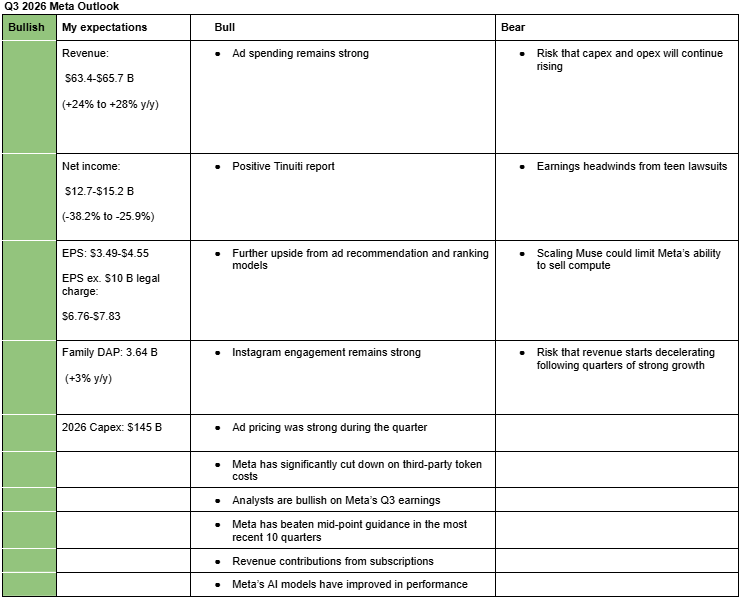
This topic discusses the upcoming Q3 2026 Meta Platforms earnings. It will include our final assessment and decision before the earnings release. We will also summarize the results here. You can find our earnings preparation and full summary of the results in the Notion:
Earnings date: October 21, 2026
Time of Earnings release: 4:00 PM ET
Time of Analysts Call: 4:30 p.m. ET
I=8 Tinuiti Ads Benchmark Report suggests Meta’s Q3 2026 revenue could grow by 28%-34%, above management’s guidance range of 19.0%-24.9%
Ad spent growth on Meta Platforms by Tinuiti advertisers accelerated to 17% y/y in Q3 2026 from 11% in Q22 2026, CPM rose 14% y/y (Q2 2026: +10% y/y), while ad impressions rose 2% y/y (Q2 2026: +2%).
Ad spend growth on Facebook rose 16% y/y (Q2 2026: +7%), ad impressions fell 6% y/y (Q2 2026:-5%), while CPM grew 24% y/y (Q2 2026: +13%).
Ad spend growth on Instagram rose 18% y/y (Q2 2026: +17%), CPM rose 1% y/y versus flat growth in Q2, while ad impressions rose 17% y/y (Q2 2026: +17%).
Ad spend growth on TikTok rose 29% y/y (Q2 2026: +31%), ad impressions rose 17% y/y (Q2 2026: +13%), while CPM grew 10% (Q2 2026: +16%).
Ad spend growth on Google Search grew 14% y/y (Q2 2026: +14%), click through rate (CTR) rose 9% y/y (Q2 2026: +13%), while cost per click (CPC) grew 4% y/y (Q2 2026: +1%).
Assessment
Tinuiti Ads Benchmark report has been historically been reliable in predicting Meta’s revenue growth.
The Q3 2026 Tinuiti Ads Benchmark Report suggests that Meta’s Q3 2026 revenue could grow by 28%-34%, above management’s guidance range of 19.0%-24.9%. The estimates take into account the average outperformance of 11% in the most recent 11 recent quarters and the average outperformance of 17% in the most recent three quarters (Google Sheets).
Interestingly, Guidelines also indicate acceleration in digital ad spending in Q3 from Q2, with ad spend in July-August growing by an average of 13.4% versus an average of 10.2% in April-May (Google Sheets), probably boosted by political advertising ahead of the November mid-term elections.
Tinuiti CPM numbers may not be reliable for Meta Platforms given they have often deviated significantly from the actuals.
I am bullish on Meta’s Q3 2026 earnings. My Q3 2026 estimates (Meta Platforms (Google Sheets) factor in strong advertising demand, positive findings from Tinuiti’s report, continued improvements in Meta’s AI recommendation and ranking models, resilient Instagram engagement, earnings headwinds from teen-related lawsuits, foreign exchange impacts, and Meta’s track record of beating its midpoint revenue guidance in the past ten quarters.
Despite my positive near-term earnings outlook, I maintain a Hold rating on the stock, given limited visibility into AI monetization and the risk of further increases in capital and operating expenditures.
Bullish arguments
Ad spending remains strong: According to Guideline, which tracks U.S. advertising spending, digital ad spend grew by an average of 13.4% year-over-year in July–August, accelerating from 10.2% in April–May (Google Sheets). Additionally, advertising checks conducted by analysts at several firms suggest that spending remained strong throughout the quarter (Notion).
Positive Tinuiti report: According to Tinuiti Ads Benchmark report (forum post), which has been consistently reliable in predicting Meta’s revenue growth, ad spend on Meta Platforms by Tinuiti advertisers rose 17% y/y in Q3 2026 versus 11% in Q2 2026. Extrapolating from this report alone, Meta’s Q3 2026 revenue could grow by more than 28%.
Further upside from ad ranking and recommendation models: Meta continues to scale its ad ranking and recommendations models (Andromeda, Lattice, and GEM). CFO Susan Li said in Q2 2026 earnings call that they see headroom to improve recommendations in 2026 and towards the end of 2027 (Q2 2026 Meta Earnings Call (Notion)).
Instagram engagement remains strong: According to Wells Fargo, growth in time spent on Instagram accelerated by 500 basis points in Q3 compared to Q2. Citizens reported that global time spent on Instagram increased 18% and 17% year-over-year in August and September, respectively. Meanwhile, Citi noted that average daily time spent on Instagram in the U.S. rose 13% year-over-year to 60 minutes in August (Notion). Emplifi’s data also pointed to continued growth in Instagram engagement (forum post).
Ad pricing was strong during the quarter: Goldman Sachs said data from Gupta Media shows that average US CPMs paid across Facebook & Instagram in Q3 were up ~8% QoQ and up ~21% YoY (lapping ~(4)% QoQ and ~3% YoY increases in Q3’25).
Meta has significantly cut down on third-party token costs: According to a recent report, Meta has cut down its usage of Anthropic models by half (forum post). Meta had projected annual spending of around $10 billion per year in Anthropic models (forum post). Therefore, I expect R&D expense growth to slow from 67% year-over-year in Q2 2026 to approximately 48% in Q3 2026.
Analysts are bullish on Meta’s Q3 2026 earnings: Analysts are generally bullish on Meta’s Q3 earnings, with some of them expecting revenue to beat consensus estimate by 1% (Notion).
Meta has beaten mid-point guidance in the most recent 10 quarters: Meta has beaten its mid-point guidance by an average of 3.7% in the most recent ten quarters (Google Sheets).
Revenue contributions from subscriptions: Meta recently launched Facebook, Instagram, WhatsApp and Meta AI subscriptions. Based on the traction of Snaptchat+, Meta’s $3.99 per month subscription for Facebook, Instagram and WhatsApp could generate at least $3.3 B in incremental revenue (forum post). Evercore estimates the subscriptions could generate $10 billion-plus in revenue and $5 billion-plus in operating income by 2028 while Truist Securities estimate it could generate more than $20 billion in high-margin revenue by fiscal year 2030 (Q2 2026 Meta Platforms Earnings (Notion)). Going into earnings, I will be watching for management commentary on the traction of Meta’s subscription business.
Meta’s AI ad models have improved in performance: Meta’s Muse Wonder Full ranked second on the Artificial Analysis Intelligence Index, a significant improvement over Muse Spark 1.3, which ranked ninth (forum post). Meanwhile, Meta’s Muse AI agent has seen strong adoption, accumulating 10.8 million downloads since its September 8 launch and maintaining the top spot on Apple’s App Store (forum post). Amid these developments, Meta’s shares have risen 13% year-to-date, reflecting growing investor confidence in the company’s execution. Some analysts estimate that Muse could generate revenue of between $20-50 billion by 2030 (Notion).
Bearish arguments
Risk that capex and opex will continue rising: Strong Muse adoption and growing investor confidence that Meta’s AI investments are beginning to pay off may encourage management to increase AI spending further. CFO Susan Li already said in Q2 2026 earnings call that their "longer-term capacity strategy aims to give us the flexibility to continue growing compute in 2028 and beyond " (Notion).
Earnings headwinds from teen lawsuits: Meta settled teen lawsuit with 52 state attorneys general for $18 billion over a 10-year period. Meta expects to recognize about $10 billion in Q3 2026 as legal expense. Several teen-related lawsuits also remain pending, potentially exposing Meta to an additional $15 billion in liabilities (forum post).
Scaling Muse could limit Meta’s ability to sell compute: According to management, selling AI intelligence offers significantly higher margins than selling compute directly (Notion). Additionally, recent reports suggest that Meta declined Anthropic’s request for computing capacity (forum post). Given these developments, I believe Meta is unlikely to prioritize selling compute in the near term. I also do not expect Muse to significantly contribute to earnings over the next two years, given Meta’s historical strategy of prioritizing user growth before monetization. Furthermore, UBS estimates that serving Muse could cost approximately $25 per user per month under certain usage assumptions, potentially offsetting much of the revenue generated from its $20 monthly subscription tier (forum post).
Risk that revenue starts decelerating following quarters of strong growth: Meta’s revenue growth could decelerate in the coming quarters as short-form video approaches maturity. According to Sensor Tower, Reels now accounts for approximately 53% of time spent on Instagram, with its share showing limited further growth. Similarly, Tinuiti data indicates that Reels’ share of ad impressions has stabilized at around 34%, suggesting that the incremental growth opportunity from Reels may be narrowing (Google Sheets).
Management guidance and analysts' estimates:
Management Guidance for Q3 (Revenue): $61-$64 billion (+19.0% to +24.9%)
Analysts’ Estimate for Q3 (Revenue): $63.4 billion (+24.0%) Analysts’ Estimate for Q2 (EPS): $6.77
Analysts’ Estimate for Q4 (Revenue): $73.6 billion (+23%)
I=10 Meta beats Q3 estimates, approve new non-voting share class
Meta’s Q3 2026 revenue rose 26% y/y to $64.6 billion, above management’s midpoint guidance of $62.5 billion and analysts’ estimate of $63.3 billion.
EPS came in at $3.83 ($7.40 excluding teen lawsuit settlement charge), above analysts’ estimate of $3.56.
Meta guided Q4 2026 revenue in the range of $73-76 billion (+21.9% to 26.9%), midpoint guidance of $74.5 billion was above analysts’ estimate of $73.6 billion (+23%).
Meta announced plans to introduce a new class of non-voting shares (Class C) in January 2027, resulting in a 2-for-1 stock split without changing shareholders’ voting power.
It narrowed its capex guidance for 2026 to a range of $135-145 billion from $130-145 billion and raised its 2026 operating expense guidance to a range of $175-179 billion, to reflect the $9.9 billion charge related to legal proceedings recognized in the third quarter.
Family daily active people (DAP) rose 3% y/y to 3.64 billion, ad impressions rose 10% y/y (Q2 2026: +14%), while average price per ad increased 14% y/y (Q2 2026: +12%).
Meta now expects Reality Labs losses in the range of $18-19 billion in 2026 (2025: - $19.2 billion) and to narrow next year to around $15 billion as it shifts investment to priority areas.
Beyond 2026, they expect to continue investing aggressively to support the core business and AI opportunities.
Meta shares rose 4% immediately after the publishing of the results.
Q3 2026 Meta Platforms Earnings Call key insights and overall assessment
Zuckerberg said Muse is very compute-intensive but expect to improve compute efficiency by more than 10x next year, which will enable it to be profitable once they scale the revenue lines.
“In the near term, Muse is very compute-intensive to run, but we expect to improve its cost efficiency by more than 10x in the next year, which will enable it to be profitable once the revenue lines are at scale,” Zuckerberg said.
“If compute efficiency continues improving quickly for another few years, which we think is highly likely, then Muse will be highly profitable over multiple years,” he added.
“I just expect that we will be able to deliver the same intelligence that we have now in Muse Wonder or frankly, any of the current frontier models at a fraction of the cost in a smaller model a year from today.”
Zuckerberg said 25% of the more than 10 million people in the U.S. and Canada who have set up Muse personal agents use it every day.
Zuckerberg said they will monetize Muse earlier than its traditional product launches due to costs, opportunity and the fact that a large part of what people are doing is commerce.
Zuckerberg said “the most common use case for Muse is shopping, with more than a quarter of people who are using Muse engaging in this with an average purchase size of over $200.”
Meta expects AI businesses to begin contributing incremental revenue in 2027.
“We’re also building several new AI businesses, and we expect that those can begin contributing incremental revenue in 2027, but more importantly, can scale meaningfully over time,” Li said.
Li said there is substantial room for further improvements in ad ranking, retrieval and content recommendations.
“The first is just the kind of traditional roadmap of performance improvements that we have in the pipeline. That is what I would describe more as business-as-usual machine learning work. That continues to be a robust and healthy pipeline”
“Our investments and product improvements across both engagement and ads initiatives give us confidence that we have a meaningful runway to grow our core business throughout 2027.”
Assessment
Meta delivered another strong quarter. While R&D expenses were lower than my estimate by approximately $2 billion, it was fully offset by higher cost of revenue (will find out the drivers in the 10-Q report). I particularly like that Meta continues to improve its ad retrieval and recommendation models and sees significant opportunities for further gains.
Looking ahead, the key factors to watch will be Meta’s ability to significantly improve compute efficiency while continuing to scale Muse. If the company fails to achieve meaningful efficiency gains, capital expenditures could remain elevated or continue rising significantly through 2028.
I would add that the creation of the new class of non-voting shares is quite relevant as they say they could use it for raising money.
While I like that Li says there is potential to grow meaningfully in 2027 with ad and engagement initiatives I disliked that many improvements she presented in the quarter led to a merely 1% improvement. Maybe we can list all those improvements e.g. in Notion and look a bit closer into them
I mapped them out here (Notion) and the reported gains in time spent from ranking and recommendation improvements appear less dramatic in Q3 2026 than in some previous quarters. Notably, Instagram Reels ranking improvements drove a more than 4% increase in Reels time spent in Q3 2026, compared with a 10% increase in Q1 2026. However, advertising conversion improvements remained meaningful, although the magnitude varied by objective. For instance, GEM enhancements drove a 9.6% increase in app ad conversions in Q3 2026, compared with a 15.7% increase in Facebook conversions from combined GEM and sequence learning in Q2 2026, and a nearly 3% increase in app ad conversions from Lattice improvements in Q3 2025.
Additionally, CFO Susan Li said in Q3 2025 earnings call that even a small improvement in performance of ads or ad conversions can translate to meaningful growth in revenue.
“There’s a lot of demand liquidity, in the system and even small scale improvements that we are able to make in terms of driving basis point improvements in the performance of ads or single digit increases in conversions relative to impressions in a given quarter off of a large base mean that we’re really able to continue to grow the absolute dollars of revenue growth in a pretty meaningful way,” Li said.
Thanks for mapping the improvements in Notion. I just realized that sheets would have been the better format as it provides an better overview esp. on mobile.
Colors can be used (not sure if that makes sense but there could be the same color for one type of improvement like GEM) or comparisons to growth rates in the past can be calculated or charts can be created that portray growth rates over time.
Created it here (Google Sheets). The problem is that Meta is running several improvements across different surfaces such that the reported KPIs in one quarter is not necessarily the same in the next quarter.
I=5 Analysts turn more optimistic on Meta following Q3 2026 results, modestly raising price targets
The analysts are increasingly confident that Meta’s AI investments are improving its core advertising business and could unlock new revenue streams through Muse. However, uncertainty around 2027 capital expenditures, compute costs and potential equity financing remains a major concern.
I=6 Alphabet shares fell 10% after the company missed both revenue and earnings expectations
Revenue rose 25% y/y to $127.58 billion, below analysts’ estimate of $128.22 billion, while adjusted EPS was $2.67 versus $3.02 expected.
Alphabet’s search revenue rose 12% to $63.35 billion, below $64.96 estimate.
Cloud revenue more than doubled to $30.7 billion, exceeding analysts’ estimate of $28.7 billion.
The company maintained its 2026 capex guidance of $195-$205 billion but said they continue to expect it to rise significantly in 2027.
Philipp Schindler, Chief Business Officer, said in the earnings call that AI is driving better ads personalization.
“The integration of Gemini models into our ads infrastructure is improving how we decode user intent and drive ads relevance.” “For instance, through several innovations in personalization modeling, we delivered 18% incremental advertiser value and an 8% increase in user sentiment on Discover Ad in 2026.”
Alphabet attributed the slowdown in Search advertising revenue growth to foreign exchange headwinds, weaker spending by some Asia-Pacific retailers due to elimination of de minimis exemption in the EU, normalization of media and entertainment advertising following the FIFA World Cup, and lower monetization of rapidly growing AI Mode queries.