Q2 2026 United Internet Earnings: Stable outlook supported by strength at IONOS and GMX & WEB.DE
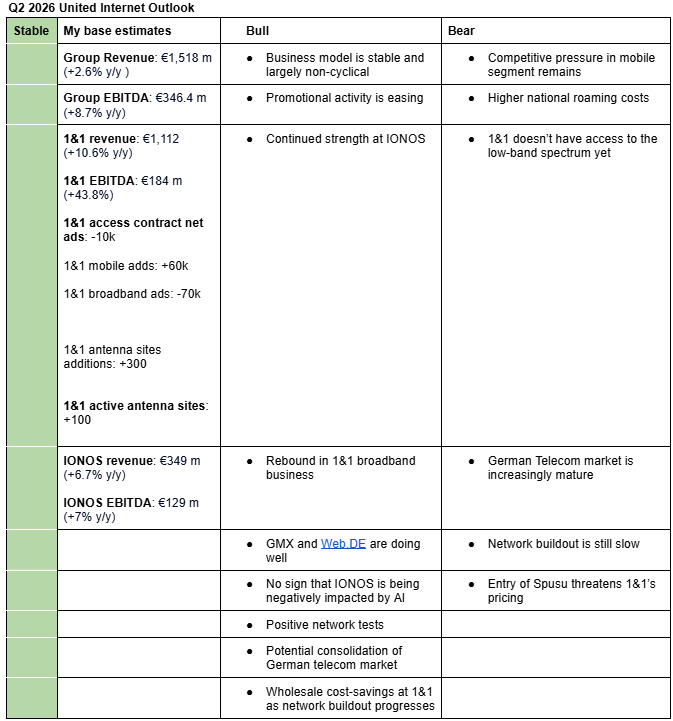
I expect United Internet to report stable results for Q2 2026. My estimates (Valuation Model (Google Sheets)) take into account continued competitive pressure in German mobile segment, potential higher national roaming costs, rebound in broadband business, and continued strenght at IONOS and GMX &WEB.DE.
Bullish arguments
- Business model is stable and largely non-cyclical: United Internet has consistently maintained (page 90) that its business is non-cyclical and its performance during times of macro uncertainty confirms it. For instance, IONOS and GMX & WEB.DE have utility-like business with high switching costs.
- Promotional activity is easing: Telefonica Deutschland, which drove much of the promotional activity last year and early this year, said on its latest earnings call that promotional intensity is easing (Q2 2026 United Internet Earnings (Notion)).
- Continued strenth at IONOS: IONOS’s average revenue per user (ARPU) rebounded in Q1 2026 after experiencing some weakness in Q4 2025, which was associated with discounts given to new customers. Additionally, customer addition remains strong (United Internet Valuation Model (Google Sheets)).
- Rebound in 1&1 broadband business: The decline in 1&1’s broadband customer contracts is slowing, alongside improving business trends in the division. Both Vodafone and Telefonica Deutschland said on their latest earnings calls that their broadband businesses are improving, but they are focusing on value over volume (Q2 2026 United Internet Earnings (Notion)).
- GMX & WEB.DE are doing well: GMX & WEB.DE (now called Mail & Media) are seeing strong growth, partly due to privacy concerns. For instance, its revenue and EBITDA rose 8% and 17%, respectively in Q1 2026 (United Internet Valuation Model (Google Sheets)).
- No sign that IONOS is being negatively impacted by AI: There were concerns that AI could pressure IONOS’s margins by making it easier for customers to build websites without its tools. However, current business trends show no signs of AI-related disruption.
- Positive network tests: Despite being a new entrant with relatively few antenna sites, 1&1’s network continues to perform well in independent network tests.
- Potential consolidation of German telecom market: Potential consolidation in the German telecom market limits the downside if 1&1’s network strategy does not deliver as expected. The European Commission appears increasingly open to consolidation, while approval of a potential Iliad–Altice transaction in France could set an important precedent. Telefonica’s CEO recently described developments in France as an “interesting sign” (Q2 2026 United Internet Earnings (Notion)).
- Wholesale cost-savings at 1&1 as network buildout progresses: 1&1 should benefit from lower costs as the number of its own antenna sites increases. National roaming costs should also decline once Vodafone’s own customer data usage grows at least as fast as 1&1’s roaming base (Q1 2026 United Internet Earnings (Notion)). Further savings are expected when 1&1 obtains low-band spectrum. BNetzA has proposed that each of the three incumbent operators pay 1&1 €6 million annually as compensation until low-band spectrum becomes available, implying a total annual disadvantage of at least €18 million at the moment (Q1 2026 United Internet Earnings (Notion)). As a result, 1&1 guides EBITDA to grow by €100 m in 2026, 2027, and 2028.
Bearish arguments
- Competitive pressure in mobile segment remains: Although promotional activity in the German mobile market is easing, it remains intense, as Vodafone and Telefónica Deutschland noted in their latest earnings calls (Q2 2026 United Internet Earnings (Notion)). As such, I expect average revenue per user (ARPU) at 1&1 to remain weak during the quarter.
- Higher national roaming costs: Based on customer trends at Vodafone, it’s possible that 1&1’s national roaming costs will come in higher than expected again. Vodafone’s mobile contracts fell by 85,000 in Q2 2026 versus a decline of 77,000 in Q1 2026 (Q2 2026 United Internet Earnings (Notion)).
- 1&1 doesn’t have access to the low-band spectrum yet: There have been no recent updates on 1&1’s efforts to secure low-band spectrum. Additionally, as noted above, BNetzA appears inclined to extend the incumbents’ existing spectrum usage rights and compensate 1&1 for not receiving access.
- German telecom market is increasingly matured: Incumbents pointed out in their Q4 2025 earnings that the German telecom market is increasingly mature (Q4 2025 United Internet Earnings (Notion)). As a result, strong growth at 1&1 through new contracts is unlikely in the near-term unless their is consolidation or OPEN RAN leads to material market share gain.
- Network buildout is still slow: 1&1 is adding around 200-300 antenna sites per quarter, indicating that the network rollout is still slow (Q1 2026 United Internet Earnings (Notion)). However, 1&1’s antenna sites appear to provide greater coverage per site than those of the incumbents: with only around 1,500 active sites, its network already covers approximately 28% of German households.
- Entry of Spusu into German telecom market threatens 1&1’s pricing: Austria’s Spusu recently entered the German telecom market with steep discount. This may threaten 1&1’s pricing.
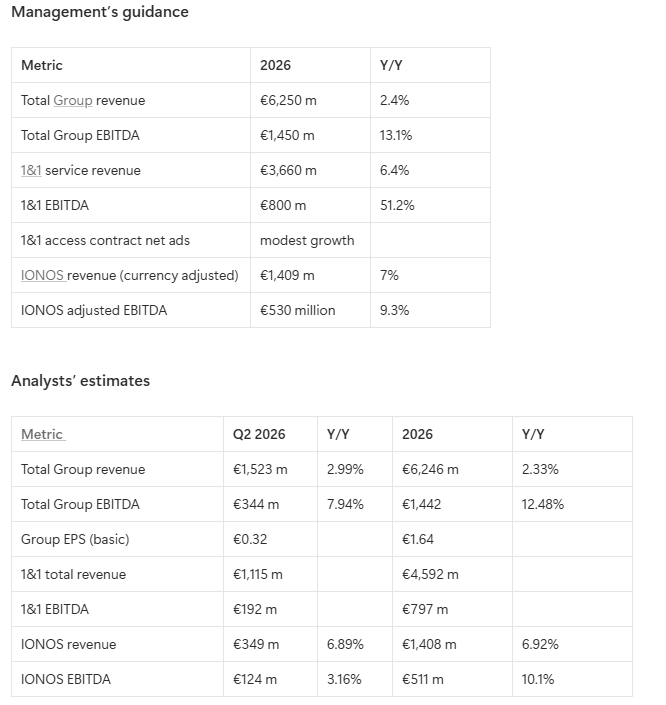
Here are analysts estimates and management guidance for Q2 2026 and FY2026: