This topic covers Match Group’s Q1 2026 earnings. A preview of the results will be posted here. For the full earnings preview and earnings call summary, see the Notion:
Earnings date: May 5, 2026
Time of Earnings release: 4:00 PM ET
Time of Analysts Call: 5:00 p.m. ET
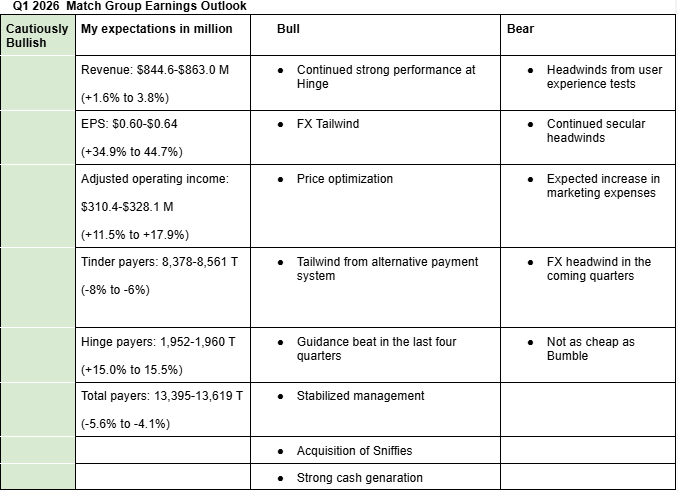
I am cautiously bullish on Match Group’s Q1 2026 earnings and bullish on the company overall. My estimates (Match Group Valuation Model (Google Sheets)) take into account continued decline in Tinder paying users, strong performance at Hinge, FX tailwind, and revenue guidance beat in the last four quarters.
Here is a description of by bullish and bearish sentiments:
Bullish arguments
Continued strong performance at Hinge: Hinge continues to deliver strong performance, with its revenue growth more than offsetting the decline in Tinder’s revenue. In Q4 2025, Hinge’s revenue rose by $38.8 million while Tinder’s revenue fell by $12.2 million. I expect Hinge to deliver another strong revenue growth this quarter as it continues gaining users.
FX tailwind: The Euro continued to strengthen against the USD during the quarter. Given that Europe accounts for around 29% of Match Group’s revenue, I expect FX to be a tailwind to Match Group’s results again. I project FX tailwind of around 2.9% versus management’s guidance of 3.5% (Match Group FX Estimates (Google Sheets))
Price optimization: There was strong price optimization at Hinge, Tinder and E&E from Q2 2025. I expect this optimization to also play out in Q4 2025 as the company seek to compensate some user growth headwinds (Match Group Valuation Model (Google Sheets)).
Tailwind from alternative payment system: Match Group’s Q1 2026 earnings and that of 2026 will benefit from the shift to direct payments, starting in second half of last year. Management expects its alternative payment system to lead to cost-savings of around $110 million this year, that’s an average of around $27.5 m per quarter, though first half should witness stronger tailwind due to the timings of the rollout (Q4 2025 Match Group Earnings (Notion)).
Guidance beat in the last four quarters: Match Group has exceeded management’s lower-point revenue guidance by an average of 1.2% in the most recent four quarters (Match Group Guidance Versus Actuals (Google Sheets)).
Stabilized management: Match Group’s management remains stable despite the departure of Hinge’s founder Justin McLeod at the end of last year (Match Group’s management (Notion)).
Acquisition of Sniffies: In my opinion, the acquisition of Sniffies, the number two player in the GBTQ space after Grindr, seems to be the right move given that the GBTQ industry is growing rapidly (forum post).
Strong cash generation: Strong cash flow generation puts Match Group in a good position to acquire attractive industry apps, as it recently did with Sniffies. Match Group generates around $1 billion in operating cash flow annually. If it identifies an AI matchmaking platform gaining traction, it could also pursue an acquisition, as its CEO suggested some months ago (forum post).
Bearish arguments
Headwinds from user experience tests and new features: Match Group continue to expect headwinds from user experience tests such as Project Aurora (combines product experimentation and marketing changes) and new features such as Face Check.The company estimates that user experience tests will create a 1.5% headwind to 2026 year-over-year revenue growth, while the Face Check rollout will create an additional 1% headwind (Q4 2025 Match Group Earnings (Notion)).
Continued secular headwinds: Dating apps such as Tinder and Bumble continue to lose users due to a combination of swipe fatigue, Gen Z’s need for authenticity, e.t.c. The trend could continue until better AI match-making features come into force, probably in the second half of 2026 (Dating Apps User Trends (Google Sheets)).
Expected increase in marketing spend: Match Group expects Tinder’s marketing expenses will rise by $50 m to $230 m in 2026 (Q4 2025 Match Group Earnings (Notion)). While this could reduce payer declines, it could also impact Match Group’s margins.
FX headwind in the coming quarters: The Iran conflict has modestly strengthened the USD. If sustained, Match Group could face FX headwinds in upcoming quarters. My current Q2 2026 estimates imply FX is roughly neutral so far, versus a +2.99% tailwind in Q1 2026 (Match Group FX Estimates (Google Sheets)). As such, persistent USD strength could put downward pressure on Match Group’s 2026 revenue guidance.
Not as cheap as Bumble: Match Group’s EV/Sales multiple of ~3.3x is more than 3x Bumble’s ~1.0x. As such, Bumble may offer greater upside potential if it executes on its turnaround and narrows the valuation gap (Bumble Valuations (Notion)).
Here are management’s and analysts’ expectations for Q1 2026;
Management guidance for Q1 2026 revenue: $850-$860 million (+2.3% to 3.4%)
Management guidance for Q1 2026 adjusted operating income: $315-$320 million (+13.2% to +15.0%)
Analysts’ estimate for Q1 2026 revenue: $854.9 million (+2.9%).
Analysts’ estimate for Q1 2026 EPS: $0.61 (+37.4%).
Analysts’ estimate for Q2 2026 revenue: $856.2 million (-0.9%)
Analysts’ estimate for Q2 2026 EPS: $0.62 (+27.1%)
I=10 Match Group beats revenue and adjusted operating income guidance in Q1 2026, provides Q2 guidance above estimates and reports improving Tinder payers and MAUs
Match Group’s Q1 2026 revenue rose 3.9% y/y to $863.9 m, exceeding upper-point management guidance of $860 m and beating analysts’ estimate of $855 m.
Adjusted operating income was $343 m, above management guidance of $315-$320 m while EPS came in at $0.66, above analysts’ estimate of $0.61.
Match Group is guiding Q2 2026 revenue in the range of $850-$860 m (-1.6% to -0.4% y/y) versus analysts’ estimate of $856 m, and adjusted EBITDA in the range of $325-$330 m, up 13% to 15% y/y (estimate: $316.7 m).
Tinder payers fell 5.2% y/y to 8.6 m, a significant improvement from -7.6% in Q4 2025 while MAU was down 7% y/y in March 2026 versus 10% in March 2025, slowest rate of decline in 31 months.
The major positive is that Tinder payers are beginning to improve. However, the company is not out of the woods yet, as Spencer noted that MAU growth could either accelerate if product efficacy improves or slow if the initial gains came mainly from low-hanging fruit.
Excluding the 4% FX tailwind, revenue growth would have been roughly flat year over year, indicating weaker underlying organic performance than the reported figures suggest.
Earnings benefited from an $11m tax-related benefit from Canadian authorities but were partially offset by higher amortization of intangibles (+$23m). Excluding the one-off tax item, FX tailwind and normalizing for the higher amortization charge, EPS would have been approximately $0.58.
Overall, I think Match Group’s earnings calls keep getting positive every quarter amidst the product turnaround.