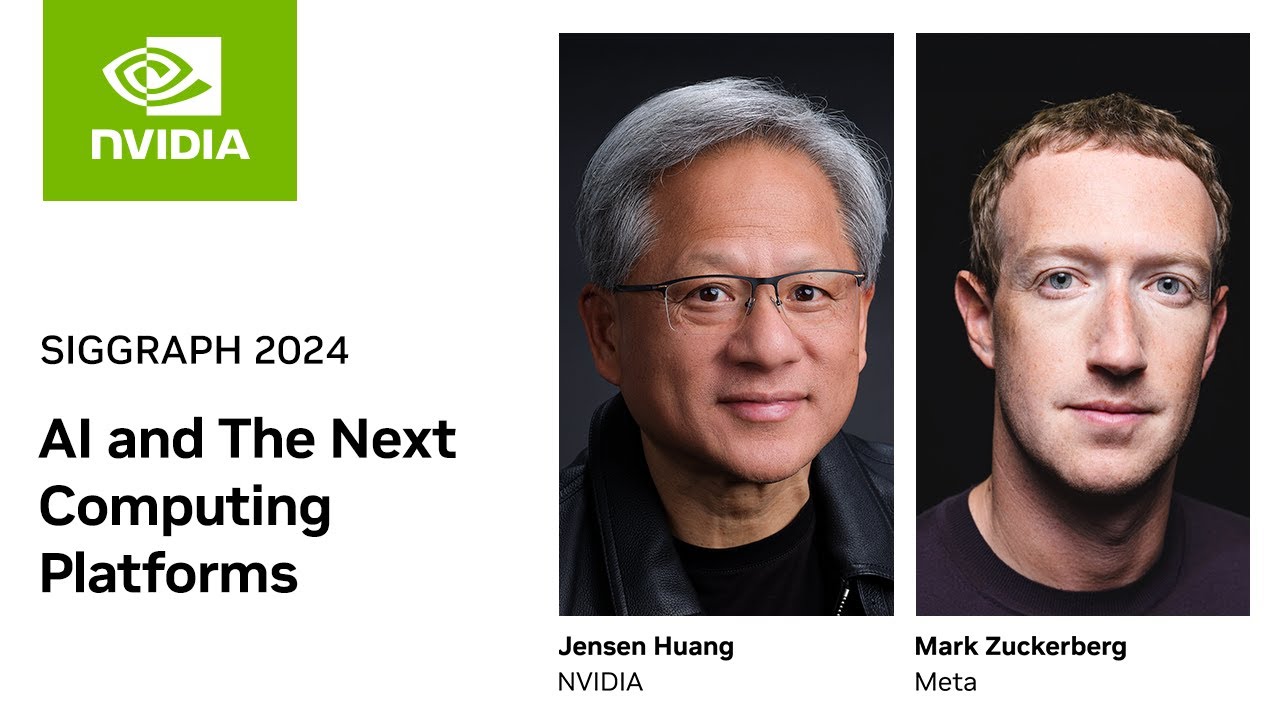
I watched the full Jensen Huang Mark Zuckerberg discussion that came along with the announcement of AI studios and was super impressed by the discussed product innovations and the reiterated highlight of the strength of Meta’s AI capabilities and teams. (As we know they build pytorch and operating large ai training clusters like they do is apparently super complex)
As I watched the live stream I couldn’t take timestamps of relevant sections so just three timestamps I looked up:
Mark talks about the new AI studio. (Min 12)
He thinks that if the progress on the foundation model stopped, they would still have 5 years of innovation to build new products just based on existing technology but thinks progress on the foundational model continues (Min 19:40)
Jensen imagines a future in which he would have an AI trained on his writing that could answer questions just like him (min 51:30)
I=1
In a joint statement, both Meta CEO Mark Zuckerberg and Spotify CEO Daniel EK pointed out that Europe risks falling behind because its policies are incoherent and complex.
I=4 Llama downloads approaching 350 million, 10x more than last year same time
Meta Platforms said Llama models are now approaching 350 million downloads (10x more downloads compared to last year this time round) and that last month alone it was downloaded more than 20 million times.
Also, between May and July 2024, hosted usage of Llama has more than doubled.
Meta said companies such as Goldman Sachs, Shoppify, Doordash, Zoom and Accenture are now using its Llama models for various functions.
Meta Platforms said it will begin training its AI using public data shared by its users in the UK, meaning that they will soon launch Meta AI in the region.
The firm pointed out that it has incorporated feedback provided by the regulatory body.
I=6 Meta AI now has 400 million monthly users and is capable of voice interactions
Meta AI now has 400 million monthly users and 185 million daily users, Meta announced.
Meta also debuted its Llama 3.2 model (with 11 billion and 90 billion parameters) which has multimodal features that allow Meta AI to have voice interactions and answer questions about images (and even edit them in new ways).
The company also said that it’s testing voice translations with Meta AI enabling translation of Reels to different languages.
Meta added that it’s expanding its business AI agents to thousands of businesses that use click-to-message ads on Messenger and WhatsApp.
Meta pointed out that more than a million advertisers now use its AI ad tools with 15 million ads created with them last month.
I=5 Meta AI to have access to Reuters content in real-time, Axios reported
Meta has partnered with Reuters to use its content in Meta AI, Axios reported citing unnamed sources.
Meta AI users will be able to access Reuters content in real time.
Reuters will receive a payment for the access, though the terms of the deal were not disclosed.
“We’re always iterating and working to improve our products, and through
Meta’s partnership with Reuters, Meta AI can respond to news-related questions with summaries and links to Reuters content,” A Meta spokesperson responded to a request for comment.
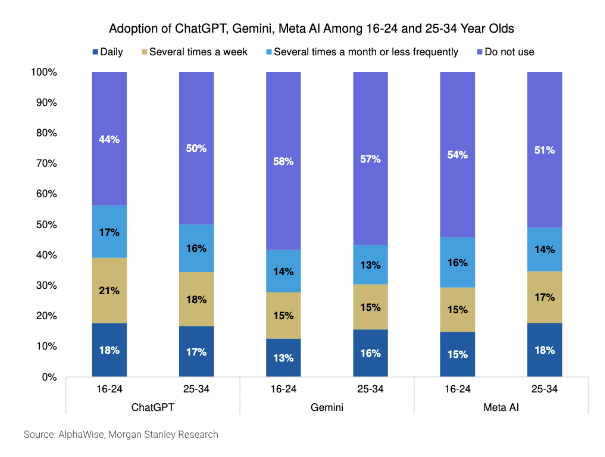
Here is the adoption of Meta AI, ChatGPT and Gemini among 16-24 and 24-35 year olds according to a survey of 2,010 consumers in the U.S. by Morgan Stanley.
“I’m thrilled to share today that I’ve joined Meta to lead a new Business AI group. Our vision for this new product group is to make cutting-edge AI accessible to every business, empowering all to find success and own their future in the AI era,” she wrote.
I=4
Buy, $675: Analyst Brent Thill of Jefferies is optimistic that Clara Shih’s experience in developing AI tools at Salesforce will be an advantage to Meta.
I=6 Meta’s vice president of AI research will leave the company
Joelle Pineau, Meta’s vice president of AI research will leave the company.
She has been with Meta for eight years and head of Meta’s Fundamental AI Research group (FAIR) since 2023.
FAIR focuses on long-term AI goals unlike the GenAI team which is responsible for the current generative AI products.
Last year, Meta reorganized its AI teams to put Pineau and Chief AI Scientist, Yann LeCun closer to the product division, a decision meant to speed up the process of getting FAIR’s research into the company’s products.
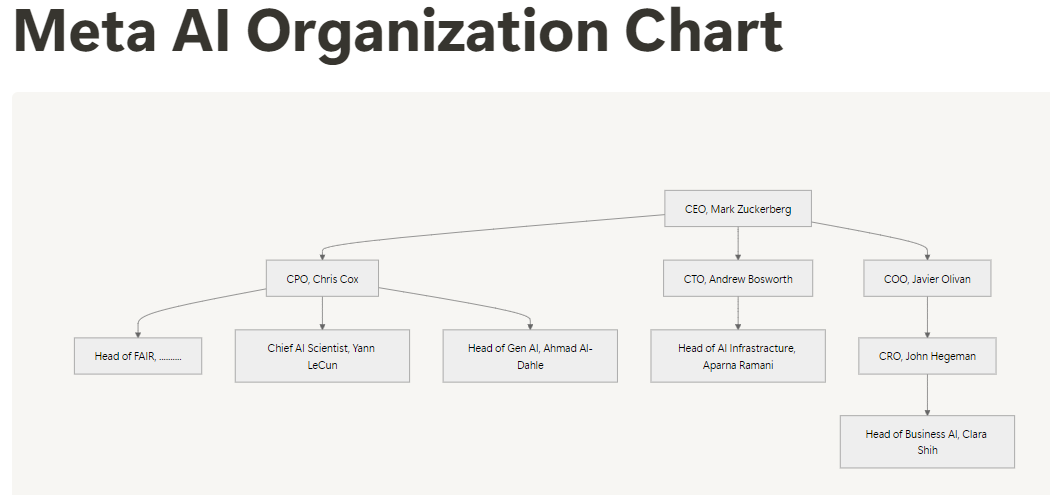
Hmm interesting. Do you think you could figure out how exactly the Meta Ai team is organized? Who is the most important? Who is in charge of developing the ai?
Other than Chris Cox, Meta’s Chief Product Officer, I would say the most important person in Meta’s AI strategy is Ahmad Al-Dahle, the Head of Gen AI. His team was responsible for the release of Llama 3 and the launch of Meta AI.
While FAIR developed the original Llama model, subsequent improvements- including Llama 3- were handled by the Gen AI team.
Oh interesting. Esp. that you found insights into the team sizes of e.g. Pineau who just left. I did not expect her team is so large (1000 people). How large is the whole Meta Gen Ai team and how does Pineaus team relate to it?
How did you find the sources and created the picture? In case it was provided by deep research link the prompt & answer within the published Notion site as well.