Assessment
The report saying Meta plans to double compute next year to 14 GW alongside recent deal announcements increases my confidence that Meta’s capex will rise again next year.
I=8 Meta launches Muse Spark 1.1, claims it outperforms Gemini on several agentic AI, coding, and multimodal benchmarks
Zuckerberg described the model as having “state-of-the-art or very close to it” agentic reasoning and tool use.
He said that Muse Spark 1.1 performed better than Google’s Gemini model in several areas related to agents, coding and multimodal capabilities.
“That is a pretty interesting milestone because I think this may be the first time, at least that I can remember, that Meta’s models are better than all of the Google models,” Zuckerberg said ahead of the release.
Zuckerberg said they are still trailing some of the larger AI labs, including Anthropic and OpenAI but believes the upcoming Watermelon model will “push this maximum frontier of intelligence.”
He declined to say when Watermelon will arrive, saying that the focus is on quality.
Muse Spark 1.1 is priced at $1.25 per million input tokens and $4.25 per million output tokens, making it more expensive than OpenAI’s GPT-5 mini and Anthropic’s Claude Haiku 4.5, but cheaper than Anthropic’s premium Claude Sonnet 4.6.
Assessment
Some third-party tests already confirm Zuckerberg’s argument that it outperform’s Gemini and is leading on a number of areas (Notion).
I=7 Zuckerberg said Meta doesn’t have excess compute yet but exploring cloud business makes sense
Zuckerberg told Bloomberg that the offers they get may make sense to consider leasing out compute instead of putting them to own internal use.
“The offers that you get for using the compute are so high that it may make sense, in some cases, to rent out or consider those kind of deals instead of your own internal uses,” Zuckerberg said.
Zuckerberg said Meta has not already overbuilt or has excess compute to lease out.
He said he’s interested on recent SpaceX’s approach to lease compute to Anthropic and Google.
“The SpaceX model I think is quite interesting in terms of just making these short-term deals that are at a big premium,” Zuckerberg said. “So we get offers for all kinds of stuff like this and we’ll evaluate them and see what makes sense.”
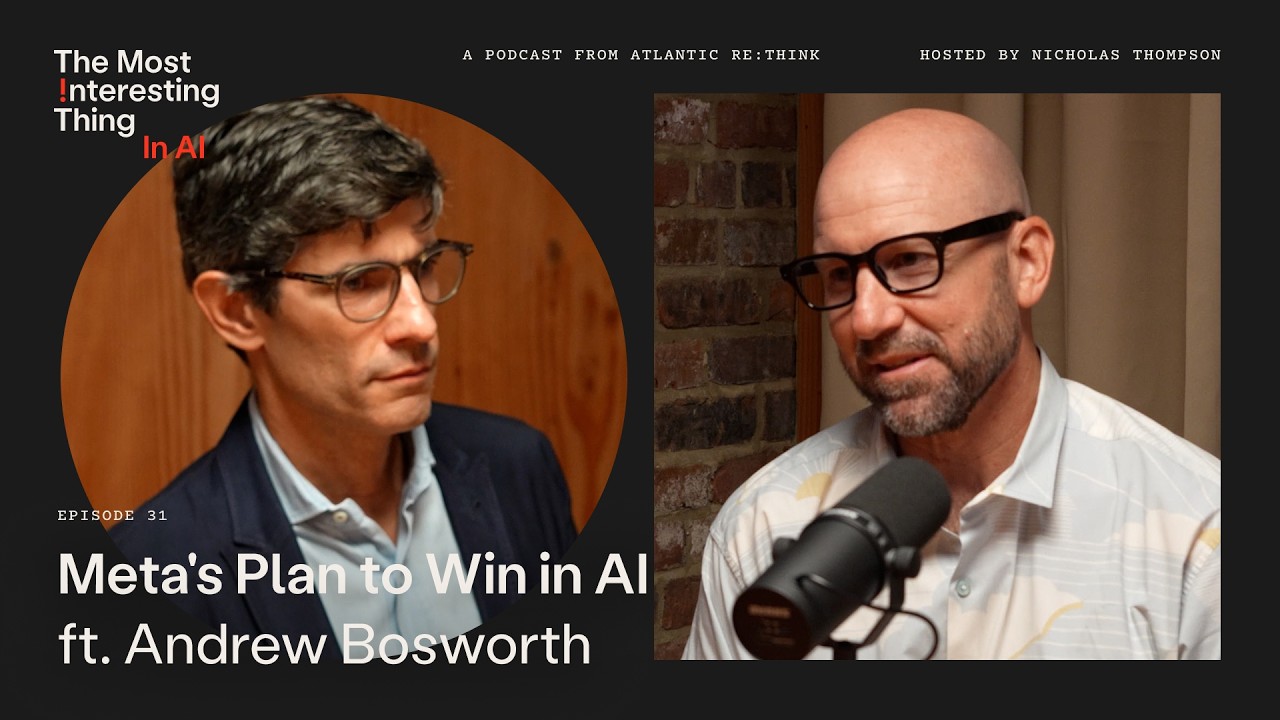
In an interview, Meta’s CTO Andrew Bosworth AI is entering the biggest period of uncertainty in the technology industry (min 0:00–0:30).
“This is the least clear vision we’ve had of even the relatively near future in a long time.”
“Two years ago we started to get a sense like, whoa, this is bigger than we thought. I think last year it got to a point of seriousness that it became an almost existential conversation.”
He said data will become the biggest competitive advantage in AI (min 15:31–17:52).
He highlighted that Meta’s AI advantage comes from consumer distribution and commerce data (min 40:31–43:40).
“Meta AI is absolutely the best at local recommendations.”
“It’s really, really good at commerce, at shopping, helping people make decisions.”
“Our ability now to give each of those people a super intelligent AI that’s going to help their business grow is great.”
He pointed out that AI infrastructure will ultimately depend on energy availability (min 47:46–48:37)
I=6 Meta discontinues Muse Image due to privacy concerns
Meta has discontinued Muse Image after receiving widespread criticism over privacy concerns.
The model was using public Instagram accounts to generate images.
“Our intent was to provide a useful creative tool and to give people control over whether their public content could be referenced in this way,” Meta said in a statement. “We’ve heard the feedback that this feature missed the mark, so it’s no longer available,” it said.
I=5 Google is months behind schedule in releasing Gemini 3.5 Pro, its most powerful flagship AI model
Citing current and former Google employees, Bloomberg reported that Gemini is months behind schedule in releasing Gemini 3.5 Pro, its most powerful flagship AI model.
This strengthens Meta’s competitive positioning and could give investors more confidence in the company’s Superintelligence efforts. Zuckerberg recently highlighted Muse Spark 1.1 as outperforming Google’s latest models across several benchmarks.
I=7 Meta plans to hire AWS Senior Vice President Dave Brown, signaling a further push into the cloud business
Meta plans to hire Amazon Web Services senior vice president, The Wall Street Journal reported.
Amazon said Dave Brown is leaving the company after 19 years to take up a new role outside the company.
Brown will report to the company’s head of infrastructure.
Brown has been at AWS since the infancy days and was part of Amazon CEO Andy Jassy’s influential S-team, a group of 28 senior executives who report directly to him and help shape the company’s key business decisions.
Bloomberg reported earlier this month that Meta is exploring cloud business and Zuckerberg later confirmed it.
I=7 Anthropic in talks to lease $10 billion of compute from Meta over two years
Anthropic in talks to lease $10 billion of compute from Meta over two years, the New York Times reported on Friday, citing three people familiar with the discussions.
The sources said the discussions are in early stages and may not result in a deal.
SemiAnalysis already hinted at these discussions last month.
Meta shares pared losses to -2.5% from -5.7% following the report, despite a broader selloff driven by continued profit-taking in chip stocks and the release of the new more powerful Kimi K3 model.
I=5 Meta is building OpenRouter-like AI routing system to cut inference costs and potentially unlock new revenue
Meta is developing “Switchboard,” an AI model-routing system that directs simple tasks to smaller, cheaper models, with the aim of lowering inference costs.
Beyond internal cost savings, Meta may commercialize Switchboard for enterprise AI developers, creating a new software revenue stream.
I=5 Meta makes its AI chatbot more like an assistant
Meta AI powered by Muse Spark 1.1 can now make plans, connect to email and calendar apps, create slides, and handle tasks on your behalf.
Additionallly, it can now conduct deep research and create content, synthesizing information from the web into reports, slide presentations, mood boards, and other outputs that you can refine in real time.