Positive outlook for Sixt’s Q3 2026 Earnings, supported by strong pricing and resilient European demand, despite elevated fleet expenses and falling residual values
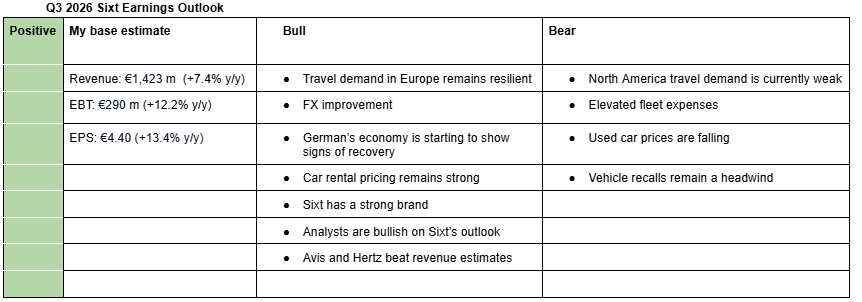
I am positive on Sixt’s Q3 2026 earnings. My estimates (Sixt’s Valuation Model (Google Sheets)) take into account strong car rental pricing, resilient travel demand in Europe, weak travel demand in the U.S., improving FX, rebound in Germany’s economy, falling used car prices, and elevated fleet expenses.
Bullish arguments
- Travel demand in Europe remains resilient: According to the International Air Transport Association (IATA), inbound travel demand in Europe rose by an average of 1% in Q3 2026 versus 1.4% in Q2 2026 and 6.1% in Q2 2026 (Google Sheets). The deceleration is due to a decline in travel from Middle East, as highlighted by Hertz in its Q3 2026 earnings call (Notion).
- FX improvement: I estimate FX tailwind of 1.6% in Q3 2026, compared to FX headwind of 1.3% and 11.1% in Q2 and Q1, respectively (Google Sheets).
- Germany’s economy is starting to show signs of recovery: Germany’s economy and outlook is turning positive (forum post), with Q3 2026 GDP rising 1.3% y/y, compared to 1.2% and 0.6% in Q2 and Q1, respectively (forum post). Sixt’s rental revenue growth has closely tracked GDP growth in the past.
- Car rental pricing remains strong: Hertz reported Americas Revenue per Day (RPD) growth of 7% in Q3 2026 while Avis reported growth of 0.2%. Both companies also highlighted continued price momentum in the current quarter (Notion).
- Sixt has a strong brand: Sixt’s brand remains strong, having been named Germany’s most popular mobility brand in YouGov’s 2026 Ranking (forum post). Sixt also continues to beat Hertz and Avis in North America customer satisfaction (forum post).
- Analysts are bullish on Sixt’s outlook: Analysts from DZ Bank, UBS, and Berenberg are positive on Sixt’s earnings and outlook (Notion). They highlighted strong travel demand, particularly in the western Mediterranean, growing brand recognition among American travelers, and rebound in Germany’s economy, offset by weak consumer sentiment in the U.S. and decline in used car prices.
- Avis and Hertz beat revenue estimates: Hertz Q3 2026 revenue rose 6% y/y to $2.62 billion, beating analysts’ estimate of $2.60 billion. Similarly, Avis’s revenue came in at $3.44 billion (-2% y/y), versus analysts’ estimate of $3.43 billion (Notion).
Bearish arguments
- North America travel demand is currently weak: Transport Security Administration (TSA) volumes were down 2.8% y/y in Q3 2026 versus around -1% in Q2 2026 (Notion). Similarly, International Air Transport Association (IATA) indicates North America travel demand was down 1.7% in Q3 2026 versus 0.7% in Q2 2026 (Google Sheets). As such, I expect rental revenue to be driven by pricing and not volumes.
- Elevated fleet expenses: Hertz pointed out in their Q3 2026 earnings call that collision, maintenance, and repair costs remains elevated (Notion). Rising fleet expenses has been one of the major headwinds impacting Sixt’s earnings in recent quarters (Google Sheets).
- Used-car prices are falling: European used car prices fell by an average of 3.4% (forum post) in Q3 2026. In Q2 2026, European used-car prices fell by an average of 0.5% in Q2 2026 and Sixt reported Europe depreciation of rental vehicles growth of 12.4% (Google Sheets). Similarly, U.S. used car prices declined 1.2% y/y in September (forum post). However, Sixt’s high proportion of vehicles covered by repurchase agreements, coupled with the fact that most of its fleet is less than a year old, could help mitigate the impact of declining used car prices. Hertz highlighted in its Q3 2026 earnings call that the “model year 2025 and 2026 vehicles have been performing very well in the market” (Notion).
- Vehicle recalls remain a headwind: Hertz pointed out that while the recall activity has improved, it remains elevated (Notion). Avis also said the same, adding that grounded vehicles led to $23 million in depreciation, interest and related costs and a 2.1% headwind on vehicle utilization (Notion).
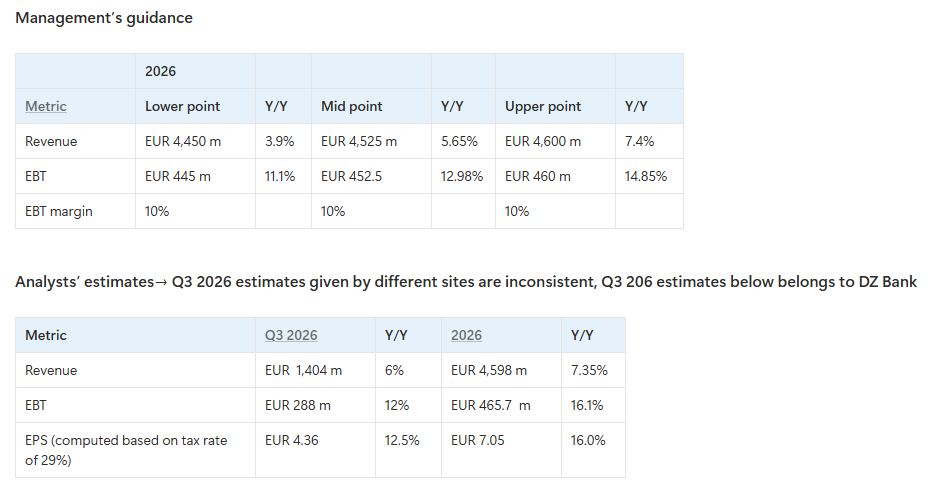
Here are management guidance and analysts’ estimates for Q3 2026 and FY2026: